
 EN
EN  RU
RU What to See on a Gobustan Tour from Baku: Petroglyphs, Mud Volcanoes & Fire
A practical guide to visiting Gobustan and the Absheron Peninsula from Baku — what you'll see, how long it takes, the best time to go, and how to do it all in one day.
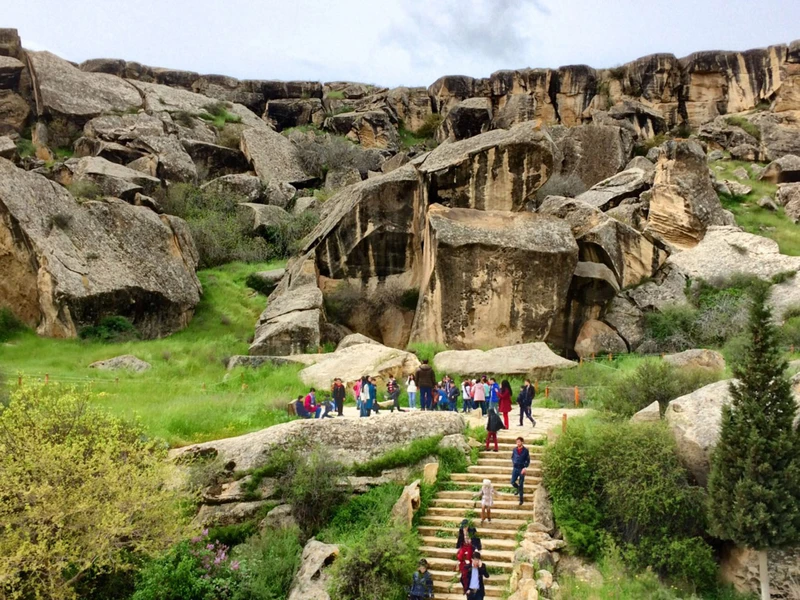
Planning a Gobustan tour from Baku? Here is everything you need to know about the UNESCO petroglyphs, mud volcanoes and fire sites.
Just an hour south of Baku, Gobustan National Park holds one of the world's great open-air archives of human history — thousands of rock carvings scratched into the cliffs over a span of 40,000 years. Pair it with the fire temples and burning hillsides of the Absheron Peninsula, and you have the single best day trip for understanding what makes Azerbaijan unique: a "Land of Fire" with roots in the Stone Age.
This guide walks through everything worth seeing, how to plan your timing, and the easiest way to do it all in one day. If you'd rather skip the logistics, our Gobustan & Absheron full-day tour covers every stop below with a local guide and door-to-door transport.
What you'll see on a Gobustan tour
The UNESCO petroglyphs at Gobustan
The heart of the trip is the Gobustan Rock Art Cultural Landscape, a UNESCO World Heritage Site since 2007. More than 6,000 engravings show hunting scenes, dancing figures, reed boats and now-extinct animals — a record of how people lived here across millennia. The modern museum at the entrance puts it all in context before you walk up to the carvings themselves.
The Gobustan mud volcanoes
Azerbaijan has more mud volcanoes than anywhere on Earth — several hundred of them — and a cluster sits near Gobustan. They don't erupt with lava; they bubble cold, grey mineral mud that you can watch (and smell) up close. The lunar landscape is one of the most photographed spots on the whole route.
Ateshgah, the Fire Temple
Crossing to the Absheron Peninsula, you reach Ateshgah, a 17th–18th century temple built around a natural gas vent that once burned continuously. It drew Zoroastrian, Hindu and Sikh pilgrims, and its central altar flame is a vivid reminder of why Azerbaijan is called the Land of Fire.
Yanardag, the burning mountain
The day usually ends at Yanardag — a hillside where natural gas seeping through the rock keeps a wall of flame alive 24 hours a day. It's most dramatic at dusk, glowing against the dark slope.
Doing it all in one day
Public transport reaches Gobustan town but not the park entrance or the mud volcanoes, and connecting to the Absheron sights without a car is impractical. The simplest, most comfortable option is a guided day trip with hotel pickup, museum tickets and a driver who knows the route. Our Gobustan & Absheron day tour from Baku includes all admissions and travels in an air-conditioned vehicle, so you spend the day seeing the sights instead of arranging them.
Frequently Asked Questions
How far is Gobustan from Baku?
Gobustan National Park is about 60 km southwest of Baku, roughly a one-hour drive each way.
Is Gobustan worth visiting?
Yes — it's a UNESCO World Heritage Site with 40,000-year-old rock art, paired with mud volcanoes you won't see in many other places on Earth. Combined with the Absheron fire sites, it's the most rewarding single day trip from Baku.
Can I visit Gobustan and the Fire Temple in one day?
Yes. Gobustan, the mud volcanoes, Ateshgah Fire Temple and Yanardag can all be covered in a single full-day tour of about 7 hours, since the route is planned to minimise backtracking across the city.
Do I need a guide for Gobustan?
A guide isn't mandatory, but the petroglyphs and fire sites are far more meaningful with the historical context — and a guided tour solves the transport problem between Gobustan and the Absheron Peninsula.
Ready to see it in person? Browse our Baku tours — small groups, local guides and instant booking.
Comments
No comments yet.
Be the first to share your thoughts!
Leave a Comment