
 EN
EN  RU
RU  AR
AR  HE
HE Ateshgah Fire Temple, Baku: What to Know Before You Visit
Visit the Ateshgah Fire Temple at Surakhani near Baku — a castle-like Zoroastrian temple built around an eternal natural flame. A focused half-day trip.
 By Kai Wild
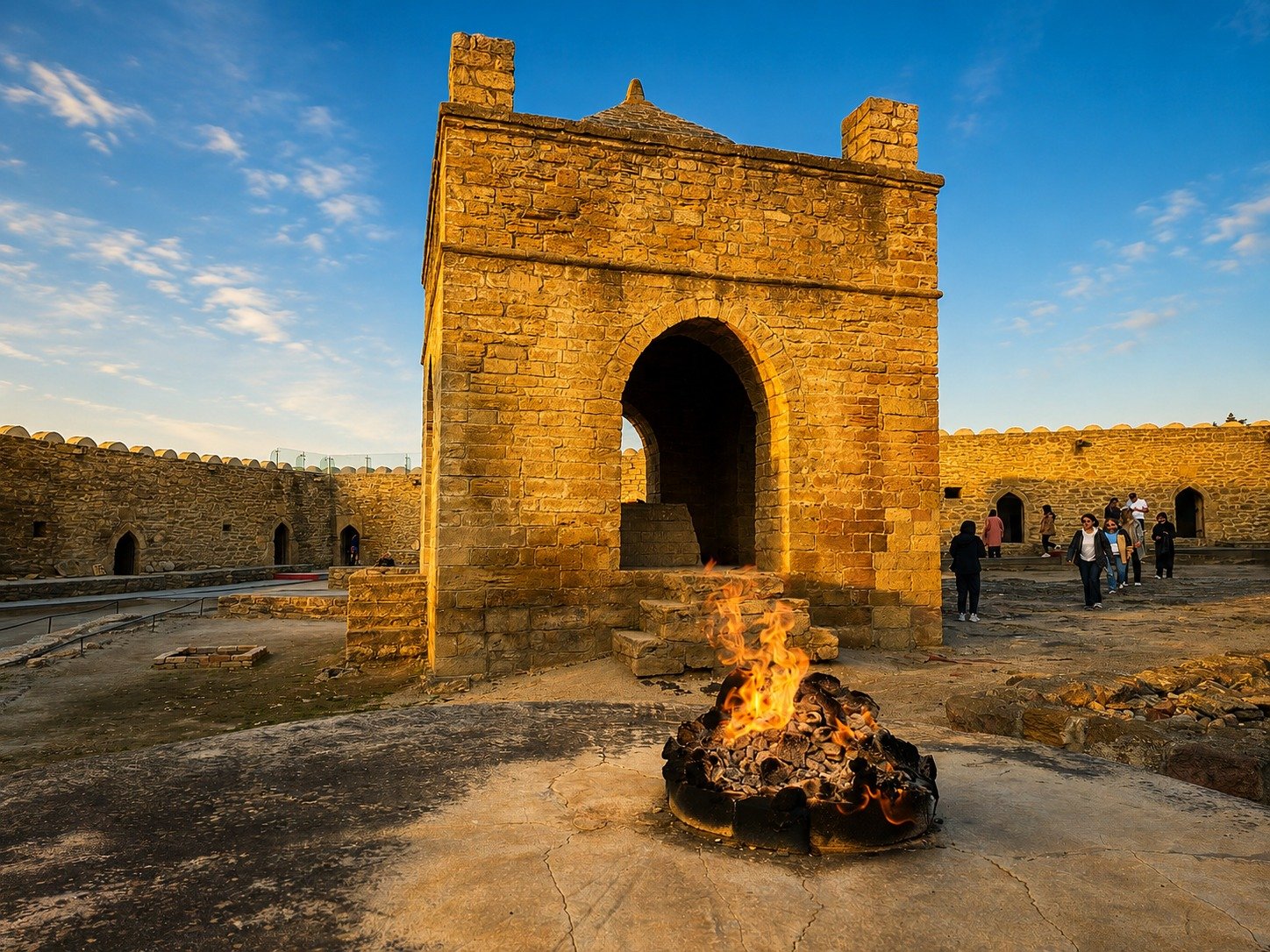
The Ateshgah Fire Temple is a small pentagonal complex in Surakhani, on the eastern edge of Baku, built around a natural gas vent that burned on its own for centuries. It is compact, unusual, and one of the few places where three religions left their handwriting on the same walls.
What it actually is
A low stone wall encloses a courtyard of monks' cells, with a four-sided altar at the centre where the flame burns. The complex as it stands was built in the seventeenth and eighteenth centuries by Indian traders who travelled the Caspian route — but the site was sacred long before that, because the ground here leaked flammable gas and nobody had to light anything.
Carved inscriptions above the cell doorways are in Sanskrit and Punjabi, with one in Persian. They are the reason the temple matters historically: Hindu, Sikh and Zoroastrian worship all left traces at a single Azerbaijani shrine.
The flame is piped now — and it is worth knowing
The natural vent that fed the fire ran out in the second half of the twentieth century, exhausted by gas extraction nearby. The flame you see today is supplied from Baku's mains. Some visitors feel cheated when they learn this on the spot, so it is better to know beforehand: the fire is a reconstruction, the temple is not.
Visiting with children
It works well for families, with the caveat that it is small. The courtyard is flat and enclosed, a child cannot get lost in it, and the flame at the centre does the explaining for you — it is the rare museum where the main exhibit is on fire. Most families are done in forty-five minutes to an hour, including the cells, which hold displays on Zoroastrianism and the caravan trade.
It is not a half-day destination on its own. Treat it as one stop among several rather than the reason for the trip.
Getting there, and what to pair it with
Surakhani is around 30 minutes east of central Baku by car. The obvious companion is Yanardag, the hillside north of the city that has been burning continuously on escaping natural gas — unlike Ateshgah, that flame is still the original one. The two together make a natural pairing: the fire that was tamed into a temple, and the fire that was never tamed at all.
Most visitors combine them with Gobustan — the UNESCO-listed rock carvings and the mud volcanoes south of the city — into a single day. That is the trip we run: Gobustan, mud volcanoes, Ateshgah and Yanardag, which takes in all four in one go with a guide and transport, and is the practical way to see them without arranging four separate taxis.
Is it worth it?
Yes, if you like small strange places and do not need them to be big. No, if you are expecting a grand monument — it is a courtyard, and you will walk it in under an hour. What makes it memorable is not scale but the specific fact of it: a fire that burned by itself for so long that three faiths built around it.
Frequently asked questions
What is the Ateshgah Fire Temple?
Is the flame at Ateshgah the original natural one?
Can I combine it with the Yanardag burning mountain?
Is it suitable for children?
What is the difference between Ateshgah and Yanardag?
What do the inscriptions above the cell doorways say?
Why was a fire temple built on this exact spot?
What is inside the monks' cells?
How far is Ateshgah from central Baku?
Is Ateshgah worth a trip on its own?
Want to see it for yourself?
The trips mentioned above are run by our own team in Baku — licensed English-speaking guides, group or private departures and free cancellation on most tours.
Comments
No comments yet.
Be the first to share your thoughts!
Leave a Comment