
 EN
EN  RU
RU  AR
AR  HE
HE 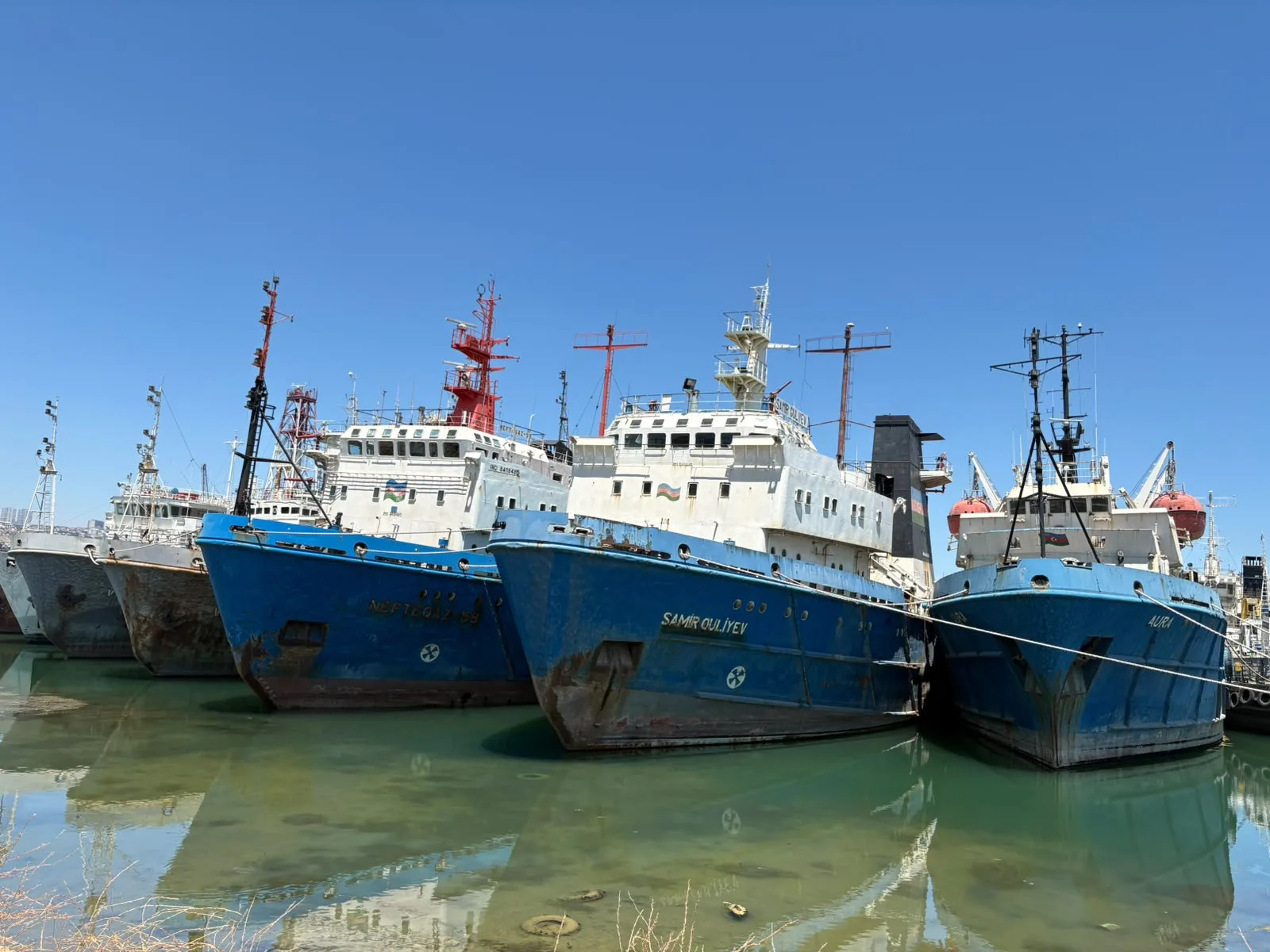
Four stops. Three completely different versions of Azerbaijan. This half-day route runs down Baku's southern Caspian coastline and collects the strangest set of landmarks in the country — a museum tanker, a live oil field, a mosque on the water's edge, and a fleet of ships that never got scrapped.
Tour overview
You start on a decommissioned Caspian tanker turned museum, moored on Baku Boulevard. Then you drive into a working oil field — the stretch Baku guides nicknamed the James Bond oil field, after the Azerbaijan storyline of The World Is Not Enough and the BMW Z8 prototype Pierce Brosnan drove in it. Pumpjacks work on both shoulders of the road.
Ten minutes later you are standing in a mosque courtyard on the shore. Bibi-Heybat is one of the most revered sites in Shia Azerbaijan, rebuilt from nothing after Soviet authorities demolished it in 1936.
Then the coast turns to rust. The tour closes at the Bibi-Heybat ship graveyard, where retired Azerbaijani vessels sit at their moorings, slowly going the colour of the seabed.
Pop culture, faith and heavy industry — inside 12 km of shoreline.
Quick facts
- Duration: about 4 hours, or 5 with the optional seafront lunch
- Stops: 4, plus an optional fish lunch on the Bibi-Heybat shore
- Route: roughly 12 km south-west along the Caspian coast
- Longest drive between stops: 20–25 minutes
- Physical demand: low — short, level walking
- Photography: permitted at all four stops
Stop 1 — Surakhani ship museum, Baku Boulevard (about 1 hour)
We begin on the water, in the city centre. The Surakhani is a Caspian tanker built in 1957 and retired into a museum, moored minutes from the Old City.
This hour is an orientation rather than a deep dive: the main deck, the bridge, and the story of how the Caspian Shipping Company — ASCO today — built its fleet through the Soviet decades. Your guide frames the whole day here: why Baku needed tankers, what ASCO still moves across the Caspian, and where ships end up when the fleet is finished with them. Which is exactly where this tour finishes.
Want the full below-deck version instead? That is the Caspian ship heritage excursion.
Stop 2 — The first mechanical oil well & the James Bond oil field (about 30 minutes)
Then we drive into the field.
In 1846, engineers at Bibi-Heybat drilled the world's first mechanical oil well — thirteen years before Edwin Drake's well in Pennsylvania, which is the one usually credited internationally. A monument marks the site beside the coastal road: a modest stone marker in the middle of an industrial landscape, and arguably where the modern petroleum industry begins.
The road runs straight through the working field. Pumpjacks nod on both shoulders. Pipework crosses overhead. Black oil pools sit at the roadside, and the air carries it.
Baku guides call this the James Bond oil field. The name comes from The World Is Not Enough, the 1999 film built around a Caspian oil pipeline and a Baku oil dynasty, whose hero drove a pre-production BMW Z8 prototype — the car later sawn in half by helicopter-mounted blades. The film set its story here; visitors come for the landscape behind it.
We stop for photographs where the derricks line up best against the sea.
Stop 3 — Bibi-Heybat Mosque (about 30 minutes)
The field ends, and the domes appear.
Bibi-Heybat Mosque sits directly on the Caspian shore, backed by cliffs, facing open water. The original complex dated to the 13th century, built by Shirvanshah Farrukhzad II over the tomb of Ukeyma Khanum, a descendant of the Prophet. Soviet authorities demolished it in 1936 to expand oil operations. Reconstruction was completed in the 1990s.
What stands today is a faithful rebuild in local limestone. Three green domes. Two minarets. Inside: gold calligraphy, mirrorwork, and a separate prayer hall for women. The terrace also gives the best overview of the shipyard and the oil field below.
It remains an active place of worship, not a monument. Modest dress is an entry requirement — shoulders and knees covered, and a headscarf for women. Scarves are available at the entrance. Your guide walks you through the etiquette before you step in, so nothing about the visit feels uncertain.
Stop 4 — Bibi-Heybat ship graveyard (about 30 minutes)
The last stop is the one people remember.
A few minutes further along the coast, a fleet of retired Azerbaijani vessels sits at its moorings and rusts. Cargo ships, tugs, offshore support craft and a drilling vessel, most of them Soviet-era, still afloat and still tied up alongside.
They are not being scrapped, and that is the interesting part. Decommissioning a merchant ship is expensive, and Caspian scrapping capacity has never kept pace with the number of vessels reaching the end of their service life. So they stay at their last working port — sometimes for years, sometimes indefinitely. Photographers have documented the same hulls in the same berths over successive years.
Ships recorded at the site have included the General Salimov, Nizami, Ashug Aleskar, General Mehmandarov and Gahraman Hasanov — several named after Azerbaijani military figures and cultural icons. The exact roster changes as ships arrive and, occasionally, are finally cut up, so your guide will tell you what is actually in front of you on the day.
This is a working port area rather than a promenade, so we visit it with the group together. The rust photographs extraordinarily well in late-afternoon light.
Optional — seafront fish lunch on the Bibi-Heybat shore (about 1 hour)
The best table on this route is a few minutes from the moorings. A fish restaurant sits directly on the Bibi-Heybat shoreline, with the Caspian filling the window and the coast running south.
Grilled Caspian fish, Azerbaijani mezze, tea afterwards. Kutum and levengi, the stuffed fish dish Azerbaijan is known for, are usually on the menu. Add it when you book, or decide on the day — it extends the tour by about an hour and turns a half-day into an unhurried afternoon.
What's included
- Private air-conditioned vehicle for the full route
- Professional guide in English, Russian, Arabic or Hebrew
- Central Baku meeting point; hotel pickup possible, agreed in advance
- Surakhani ship museum entry
- Bibi-Heybat Mosque visit
- Guided stop at the ship graveyard
- Bottled water, fuel, parking and road tolls
What's not included
- Lunch at the seafront fish restaurant — optional add-on, or pay directly at the table
- Personal expenses and tips
- The full below-deck Surakhani excursion, which is a separate tour
- Boarding any vessel at the ship graveyard
Who this tour is for
A good fit if you want maximum variety in half a day, like industrial and film-related landmarks, are visiting Baku for the first time, or are travelling with mixed interests in one group.
Probably not for you if you want to spend serious time inside a ship — take the heritage excursion instead — or if a working oil field with open oil pools is not your idea of scenery.
Practical information
Best time to visit. Year-round. Afternoon departures suit photographers, since low light on the moored hulls produces the strongest images of the day. Spring and autumn bring the most comfortable coastal weather.
At the mosque. Bibi-Heybat is an active mosque. Entry requires covered shoulders and knees for everyone, and a headscarf for women. Shoes come off at the prayer hall door. Headscarves are provided at the entrance.
Accessibility. All four stops are level, with short walks.
Before you go. Read our guide to the Baku ship graveyard at Bibi-Heybat, or browse every Caspian Sea tour in Baku.